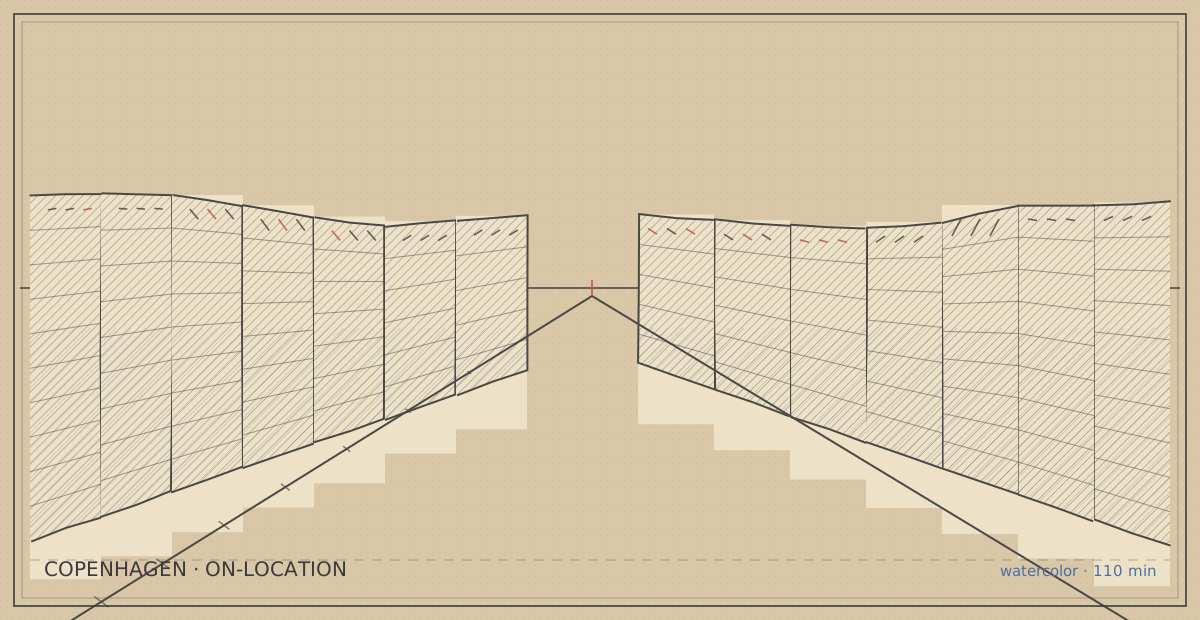
The harbour bath in October, with nobody in the water
A harbour bath is a strange subject because it is a piece of infrastructure pretending to be a beach. In October the pretence drops — the water is 11°C, the lifeguard towers are empty, and what is left is a set of wooden platforms and ladders sitting in the middle of a working harbour.
Place card — Islands Brygge harbour bath, the north jetty
| Kind | Spot sketch |
|---|---|
| Coordinates | 55.6929, 12.5993 |
| Country | Denmark |
| Medium | Watercolour |
| minutes on site | 110 min |
| Tools in the bag | Isabey 6224 No.6 · Escoda Prado No.4 · 12-pan travel palette · Stillman & Birn Beta A5 · 400 ml water · folding stool |
| First published | 23 Oct 2026 |
The first decision: architecture, not scene
Drawn as a scene, the bath is a wide view of water with some wooden shapes in it, and water drawn as a wide view is the single hardest thing in watercolour. Drawn as architecture, it becomes much easier and much better: platforms, ladders, mooring posts, a railing, with the water as negative space between them.
The rule that follows from this: the horizon is not the subject and should be drawn last. If it goes in early, everything else gets arranged around it and the page becomes a landscape. Put it in at the end, at the eye level you actually had while sitting on the jetty, and the platform drawings organise themselves around it as a plan view.
The cold-water palette
The summer palette for this subject — cerulean, warm greens, ochre in the wood — is entirely wrong in October. Water at 11°C and a flat overcast sky produce a narrow, cool and fairly dark range, and the woodwork goes grey-brown.
| Area | Mixture | Note |
|---|---|---|
| Near water, in shadow of the platform | Payne's grey 2, ultramarine 1 | The darkest water on the page; do this first |
| Open water, mid distance | Ultramarine 2, cerulean 1, a touch of burnt umber | The umber is what stops it looking tropical |
| Water over the pale sand bar | Cerulean 1, water only, one pass | This is the lightest water and the page's highest value |
| Jetty decking, dry | Raw sienna 1, Payne's grey 1, lots of water | Never ochre alone; it reads as summer |
| Jetty decking, wet edge | The same mix plus ultramarine | Wet wood is cooler than dry wood, not darker |
| Ladder rails, metal | Payne's grey neat, thin | Two passes, no third |
The single highest-value shape in the drawing is the pale band where the shallow water sits over sand. Finding it and leaving it is worth more than any amount of colour work on the platforms.
The empty bath is the point, not a limitation
In July this drawing would be about people. In October the subject is the *absence* of them, and that is a better drawing, for one specific reason: the platforms and ladders have been designed around bodies, so a ladder with nobody on it still describes a human figure's size and posture.
Three cues that carry this:
- The handrails are at exactly 1.1 m — drawing them accurately is what tells the viewer the scale of everything else
- The depth markings painted on the platform edge (the numbers 1.2 and 2.4) are a second scale cue, and they are the only text in the drawing, so they must be clean
- One abandoned towel, drawn as a single soft shape on the decking, does more for the story than any figure would
The cold-shock reaction is also why the water surface is so smooth. There is no wind and nobody swimming on an October morning, and a smooth sheet of water drawn with a single flat wash is a different subject from the choppy summer version. Resisting the urge to add wave marks is most of the work.
Working fast, because the light does not hold
Flat overcast is stable, which sounds like an advantage and is not: it gives you no shadows for a full two hours, and the drawing needs a value structure that overcast light does not provide. The workable window is the 40 minutes either side of a break in the cloud, when a soft sun puts a shadow under the platform edge.
| Time | Condition | Action |
|---|---|---|
| 09:40–10:20 | Flat, no shadows | Pencil the platforms, mix colours, no paint |
| 10:20–10:55 | Sun through, soft shadows on the decking | The whole tonal pass, in 35 minutes |
| 10:55–11:30 | Flat again | Line work: ladders, railings, depth markings |
| After 11:30 | Rain front, water goes lead-grey | Stop; the drawing is finished or it is not |
The 35 minute tonal pass is the honest constraint of a Nordic autumn. Everything else in the session is arranged around being ready to start painting the second the sun comes through.
On water temperature: 11°C, measured. Two swimmers did turn up at about 11:20 and were in for under four minutes each. They are not in the drawing, but they are the reason the window above is correct.