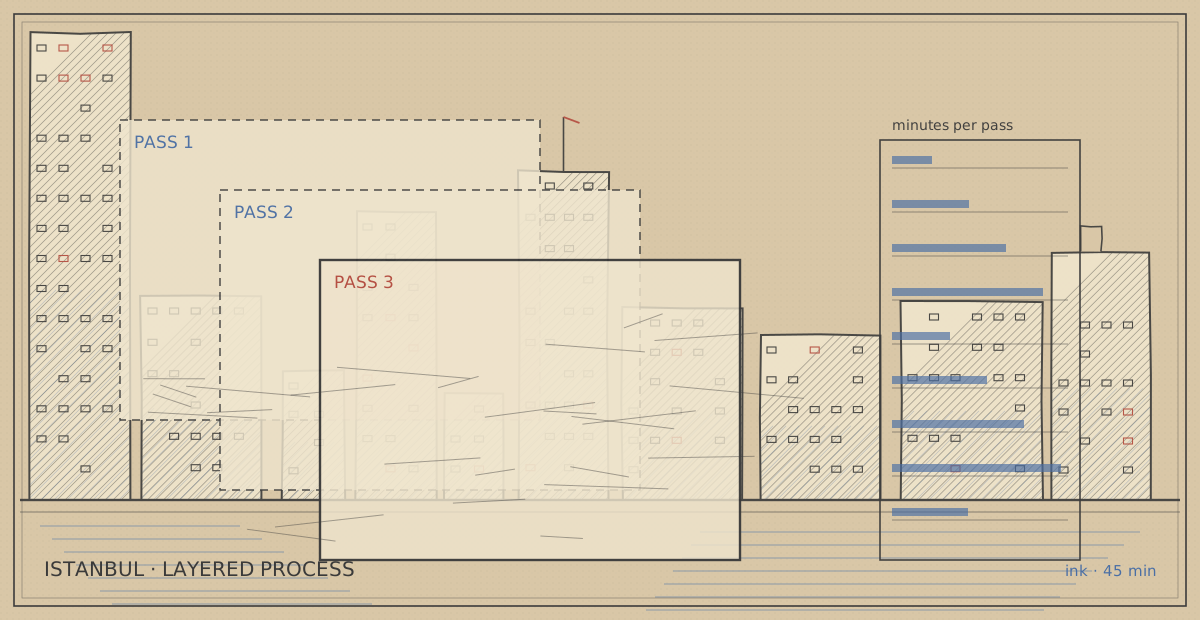
Nine blind contours in 45 minutes, and what the ninth one knows
A blind contour is the cheapest diagnostic in drawing. It costs two minutes, it cannot be faked, and it exposes exactly one thing: whether your hand is following your eye or your memory of what the thing looks like.
Place card — Karaköy, a bench facing the ferry landing
| Kind | Layered process |
|---|---|
| Coordinates | 41.0256, 28.9744 |
| Country | Türkiye |
| Medium | Ink |
| minutes on site | 45 min |
| Tools in the bag | Kuretake brush pen · Sakura Pigma Micron 05 · Stillman & Birn Alpha A5 · a timer |
| First published | 1 Nov 2026 |
The rules, and why each one exists
| Rule | Why |
|---|---|
| One continuous line per subject | A break is a decision, and decisions are where memory takes over from observation |
| Eyes on the subject, never on the paper | Looking down is what makes the hand draw a symbol instead of a shape |
| Two minutes per subject, timed | Untimed, a blind contour drifts into a careful drawing and stops testing anything |
| No lifting the pen | Lifting lets you restart a shape, which defeats the point |
| One line weight only | The drill is about contour, not tone; a second weight is a distraction |
The timer is not a discipline affectation. At ninety seconds the drawing is still observation; at four minutes the hand has started to correct from memory, and by six minutes it has become a normal (and worse) drawing that merely avoids looking down.
The nine subjects, and the timing
| # | Subject | Time | Outcome |
|---|---|---|---|
| 1 | The ferry landing's railing | 2 min | Wrong; the railing's perspective collapsed |
| 2 | A moored ferry, bow-on | 2 min | Bad; too many parts, the line wandered |
| 3 | A man waiting, side view | 2 min | Surprisingly good; one line, correct posture |
| 4 | The same man, front view | 2 min | Worst of the nine. See below |
| 5 | A bollard and its rope | 2 min | Good; the rope's curve was found, not assumed |
| 6 | A seagull on the railing | 2 min | Bad; a bird is mostly a silhouette, not a contour |
| 7 | A tea glass on the bench | 2 min | Good; small, close, and the ellipse was right |
| 8 | The ferry again, now broadside | 2 min | Better than #2 by a wide margin |
| 9 | The man again, three-quarter view | 2 min | The one that worked |
Twenty-two minutes of drawing across forty-five, with the rest being the reset between attempts and a slow lap of the landing to pick subjects.
Why number four is always the worst
This is the pattern, and it is consistent enough to plan around.
Attempts 1–3 are still observation; the hand has not yet built a shortcut. Attempt 4 happens when the hand has just enough information about the subject type to start substituting, and not enough to substitute well. So it draws a *symbol of a man* — the front view, the one with the most symmetry and the least information — and it does so with total confidence, which makes it much worse than attempts 1–3, which were at least honestly confused.
By attempt 9, with the subject changed twice in between, the substitution habit has been broken and the hand goes back to following the eye. Number 9 works not because it is the ninth but because it is the first one after a reset.
The practical rule: when a subject type starts going wrong, change subjects for two rounds, then come back. Never push through on the same subject.
What the drill transfers to real drawings
Three things, and they show up in finished work within a week.
The ellipse test. A tea glass at sixty centimetres is an ellipse, and the eye knows its proportions better than the hand. After this drill, round objects in normal drawings stop being drawn as the ellipse you expect and start being drawn as the ellipse that is there.
The rope and cable problem. Rope, cables, handrails and railings are long curves with nothing to measure them against. The blind contour trains the hand to find a curve's shape by following it, instead of breaking it into segments, which is the single most common way a harbour drawing goes wrong.
Correction pressure. The urge to go back and fix the third line is the same urge that ruins a moving subject. Ninety seconds of not lifting the pen is a repeatable way to practise not doing it.
Ferry timing, for anyone copying this: the Karaköy–Kadıköy ferry runs every 15–20 minutes off-peak, which is roughly one new subject every six minutes and is the ideal rhythm for this drill. Sit on the bench facing the landing, not the water.