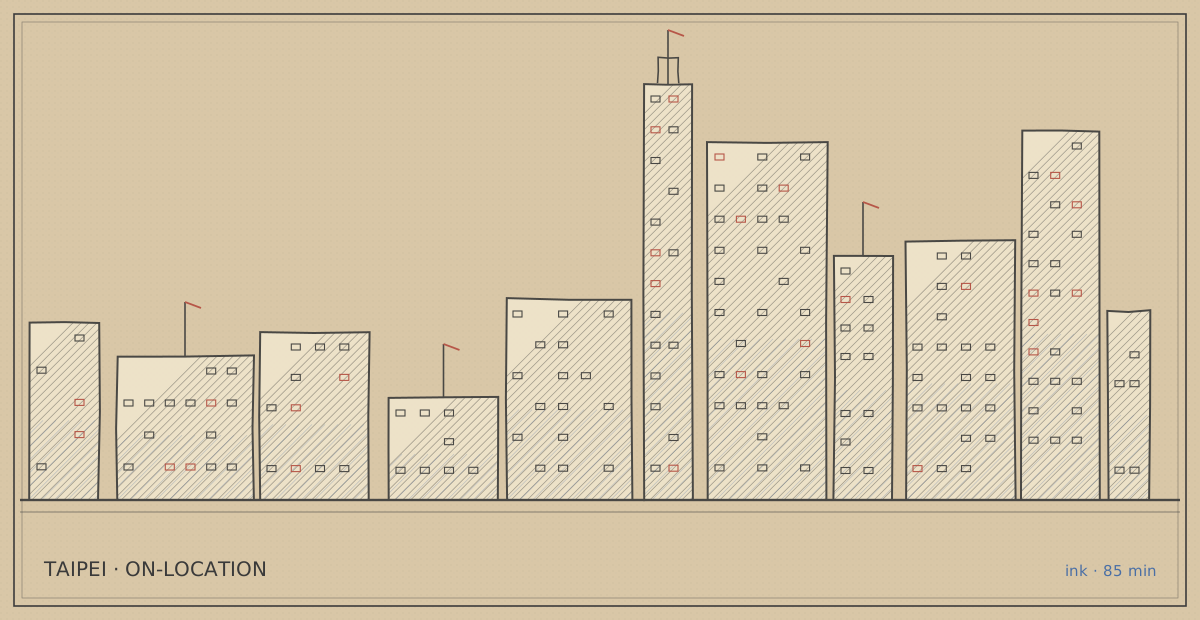
Yongkang Lane 31, where the awnings eat the sky
There is no sky in this lane. Between the two rows of buildings sit four levels of awning, three runs of cable, a dozen air-conditioner boxes and the undersides of everything, and that stack — not the architecture — is what the lane actually looks like.
Place card — Lane 31, Yongkang Street
| Kind | Spot sketch |
|---|---|
| Coordinates | 25.0335, 121.5290 |
| Country | Taiwan |
| Medium | Ink |
| minutes on site | 85 min |
| Tools in the bag | Sakura Pigma Micron 05 · Sakura Pigma Micron 025 · Stillman & Birn Alpha A5 · folding stool |
| First published | 10 Sep 2026 |
The problem with drawing a layered mess
A lane like this destroys people who draw it outline-first. The boundaries between an awning, the wall behind it and the box behind that are all the same weight of grey, and if you outline each object separately you end up with a page of overlapping wire that reads as nothing at all.
The fix is to stop treating the objects as objects and start treating them as bands of tone at different depths. The nearest awning is the darkest thing in the lane because you are looking at its underside. The wall behind it is the lightest, and the second awning is a middle value. Three values, three depths, and the drawing holds together even before a single detail goes in.
Depth bands, drawn in this order
| Band | What it is | Wash or line | Where it sits on the page |
|---|---|---|---|
| 1 | Nearest awning underside | Densest hatch, 0.5 mm spacing | Across the whole top third |
| 2 | Second awning, in light | Outline only, no hatch | Middle band, right side |
| 3 | Wall behind everything | Left blank except windows | Visible in about four gaps |
| 4 | Ground, cable runs, boxes at knee height | Medium hatch following the lane | Bottom third |
Drawing in that order matters more than drawing well. Band 3 — the wall — is drawn almost not at all: it only exists in the four places where you can see it through the stack. Painting it in as a full wall is the single most common mistake here, because the eye then reads it as the nearest surface.
Air-conditioner boxes are the rhythm
I counted fourteen boxes down one side of the lane in eighty-five minutes, and not one of them is at the same height as its neighbour. They are the only irregular element in a lane that is otherwise governed by the parallel lines of the awnings, and that makes them the thing that keeps the drawing from looking mechanical.
They also give you a free depth cue. A box mounted on the near wall is drawn large with a visible bracket and a drip stain below it; the same box three doors down is drawn as a small rectangle with one hatching line and no bracket at all. Making that reduction deliberately — rather than because you ran out of time — is the difference between a sketch and an unfinished sketch.
The cables, and how not to draw them
Three runs cross this lane. Drawing all three as continuous catenaries produces the worst page of the session: thirty parallel lines that flatten the whole drawing into a curtain.
What worked: draw only the nearest run, in full, with the sag. Draw the second run only where it crosses a gap between awnings, so it appears in four short segments. Ignore the third entirely. The viewer completes the rest, and the lane keeps its depth.
- Time: 85 minutes, 20 of them standing up while a delivery truck occupied the spot
- Stool position: against the shutter of a closed noodle shop, facing uphill
- One mistake kept in: the second awning is drawn 15% too tall, which is why the right side reads slightly deeper than it is
- Gear note: the 0.25 nib did the entire awning stack and never clogged, which is not always true in this humidity