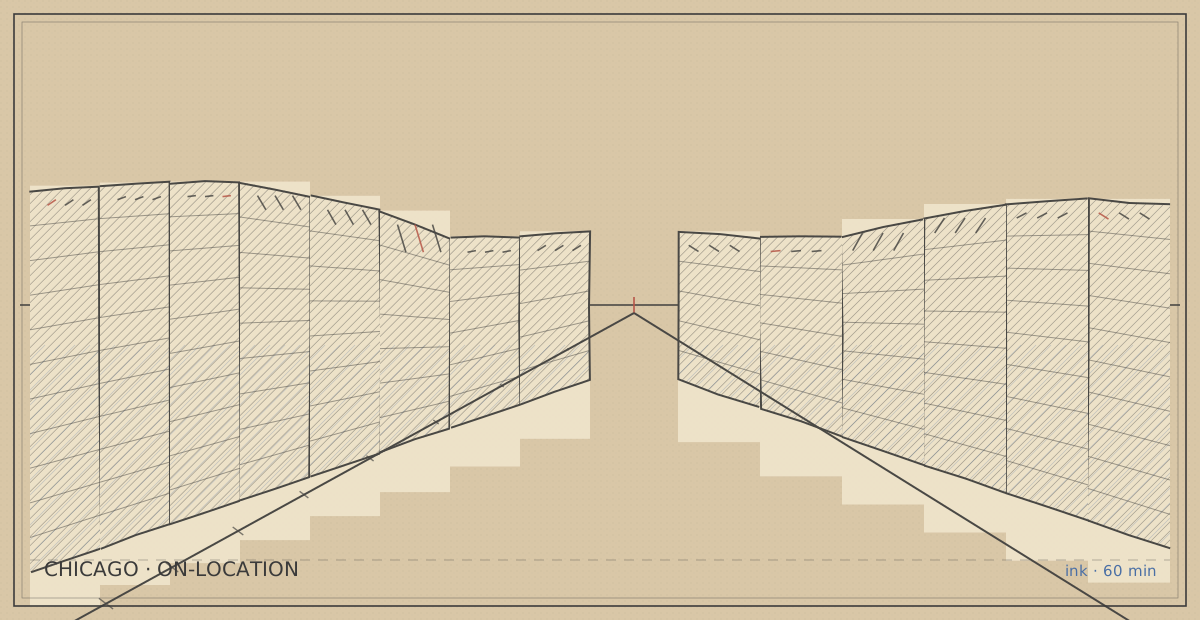
Sixty minutes on the Quincy platform, between two trains
Most people draw the L from the street, looking up at it. Standing on the platform puts you inside the structure — surrounded by columns, roof girders and the track bed — and that changes the drawing completely, because you are now drawing the thing you are standing in rather than an object in front of you.
Place card — Quincy L station, platform level
| Kind | Spot sketch |
|---|---|
| Coordinates | 41.8786, -87.6338 |
| Country | United States |
| Medium | Ink |
| minutes on site | 60 min |
| Tools in the bag | Sakura Pigma Micron 045 · Sakura Pigma Micron 025 · Stillman & Birn Alpha A5 |
| First published | 5 Oct 2026 |
What changes when you are inside the structure
From the street, the Loop is a silhouette: a dark elevated band across a bright building. From the platform it is a room, and like any room it has a floor line, a ceiling and a set of verticals that converge in two directions rather than one.
The practical consequence is that the eye level is no longer a guess. Standing, it is about 1.6 m, and it is visible in the drawing as the line where all the platform-level columns converge. Mark it first, in pencil, across the whole page, and check every column against it. Columns above the eye level converge downward; below it, upward. Getting one column on the wrong side of that line is the difference between a room and a diagram.
The structure, counted
| Element | Count visible from mid-platform | Notes |
|---|---|---|
| Roof girders across the tracks | 9 | All identical, spaced roughly 4.5 m |
| Columns on the platform | 12 | 8 of them above eye level in the frame |
| Track bed edge, both directions | 2 | The strongest horizontals on the page |
| Roof purlins running lengthwise | 14 | Read as parallel lines, drawn as 5 |
| Overhead line supports | 6 | Interrupt the girder rhythm, useful |
The purlins are where you have to be selective. Fourteen lines drawn as fourteen lines turns the top of the page into a grey haze; five lines, with the rest implied by the girder intersections, gives the same information with a tenth of the ink. Reduction like this is not laziness, it is what a drawing does that a photograph does not.
The trains are the reason this drawing works
A Brown Line train every nine minutes, in both directions, means roughly four trains in a sixty-minute session. Each one does three things:
- It blocks the far end of the platform, which removes the temptation to draw the vanishing point you cannot see anyway
- It adds a large dark shape at mid-height and a set of window rectangles in a bright, empty band
- The passengers' movement, even drawn as nothing, gives you the moment to re-check the eye level
The third is the useful one, and it is the reason to draw here rather than on an empty platform. Every nine minutes, someone walks past at a known height, and you can check your eye level against a real person without having to draw them. If the head of a passing adult sits below your marked eye line, the line is too high, and it is worth lifting the pen and moving it.
Keeping the moving parts still
Trains are more useful as absence than as presence in a sixty-minute drawing. The compromise I settled on: draw the platform, the structure and the far end completely, and draw the train as one dark band with the windows as unhatched rectangles — no wheels, no doors, no coupling detail. A train drawn in full takes about fifteen minutes and then leaves, and the drawing has a hole in it with a beautifully rendered train inside.
The passengers are not drawn at all. Not out of puritanism, but because on a platform the crowd moves in a way that makes individual figures arbitrary, and the drawing is about the structure. Where people would be, there is just the unhatched platform.
- Trains: four in sixty minutes, two of them drawn as dark bands
- Eye level correction: made twice, both times after a passenger walked past
- One thing done properly: the track bed edge has a hard, single continuous stroke for its whole length, which is what makes the whole page hold together
- Weather note: the platform roof leaks in exactly one place, four metres to the north end