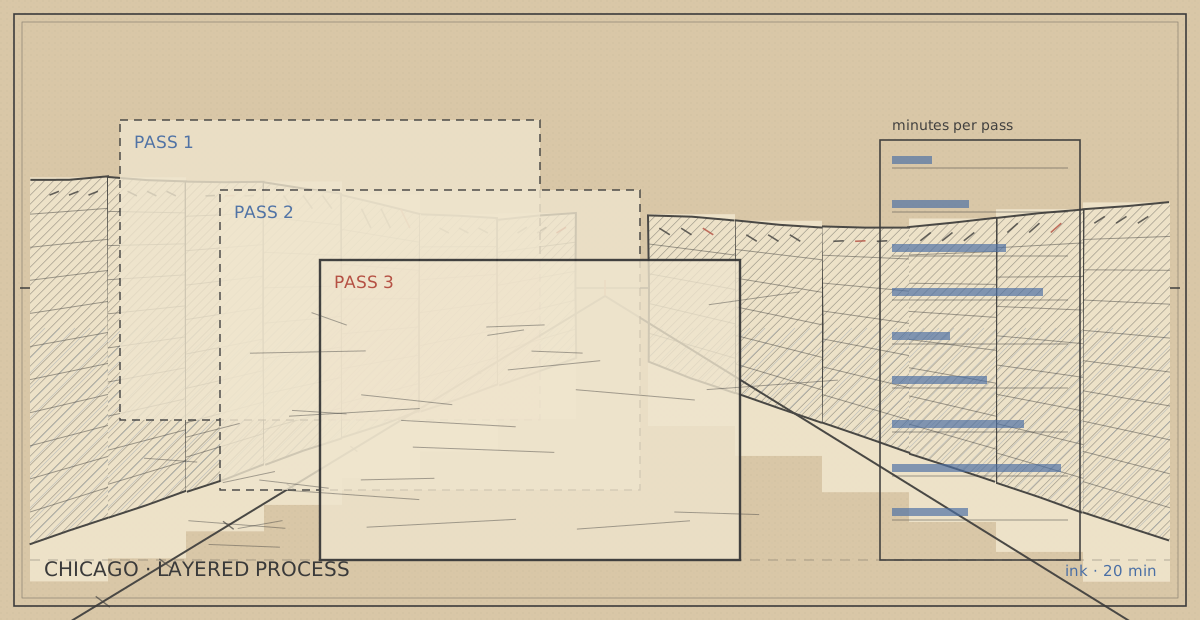
Twenty minutes, four blocks, and a hard stop
The value of a twenty-minute drawing is not that it is fast. It is that it forces every decision to be made in advance and makes it impossible to hide a bad one behind more work.
Place card — Quincy L station, the Loop
| Kind | Layered process |
|---|---|
| Coordinates | 41.8786, -87.6338 |
| Country | United States |
| Medium | Ink |
| minutes on site | 20 min |
| Tools in the bag | Sakura Pigma Micron 045 · Stillman & Birn Alpha A5 · 0.5 mechanical pencil |
| First published | 26 Sep 2026 |
The four blocks
| Block | Minutes | Tool | What happens |
|---|---|---|---|
| 1 | 3 | Pencil | Envelope and eye level only. No interior lines |
| 2 | 11 | Micron 045 | Every structural edge, one continuous stroke each |
| 3 | 4 | Micron 045 | Hatching, three values maximum, no crosshatching |
| 4 | 2 | Micron 045 | Three or four emphatic strokes, then stop |
The pencil block is where the routine is won or lost, and three minutes is deliberately short. Long enough to place the eye level and the outer envelope of the subject; not long enough to start drawing windows, which is the habit that makes timed drawings fail. If the envelope is wrong at three minutes, the drawing is wrong, and the honest move is to start a new page rather than fix it in ink.
Why the ink block is the longest and gets no hatching
Eleven minutes of nothing but structure is uncomfortable, because a page of pure outlines looks unfinished and the instinct is to start filling it in. Holding the line for eleven minutes is the actual skill being trained.
The L station at Quincy is a good subject for it: a steel structure of roughly 40 visible members, all of them reading as edges rather than as surfaces. Drawing that as edges only, with each member getting one continuous stroke, produces a drawing that is legible before any tone exists — and it has to be legible, because at twenty minutes the tone pass is four minutes and cannot rescue a weak structure.
The tone pass, with a three-value ceiling
Four minutes and three values: light (paper), mid (hatch at 2 mm), dark (hatch at 0.8 mm plus one crossing layer, and only inside the structure's shadow). No gradients, no modelling, no fourth value.
The thing that makes this work at speed is deciding where the dark goes *before* the block starts. On the Quincy drawing it went to the underside of the track bed and to the shadowed half of the stair enclosure — two places, decided in the pencil block, executed in four minutes. A timed drawing where the dark is decided during the tone pass always overruns, because deciding and executing at the same time is roughly twice as slow as doing either alone.
The hard stop, which is the actual exercise
At twenty minutes the pen goes in the bag, whether or not the drawing is finished. This is not discipline for its own sake. Three things happen when you stop on time:
- You find out what your twenty-minute ceiling actually is, which is the only way to plan a real sketch out in the field
- The unfinished parts stay visible, so the next drawing starts with a specific question rather than a general intention
- The page stops being precious, which is the single biggest blocker for anyone drawing in public
The Quincy page has an unfinished left third. The people who look at it do not see a mistake; they see a drawing that is going somewhere. That is worth more than three more minutes of hatching, and it took me about a year of drawing past the timer to believe it.