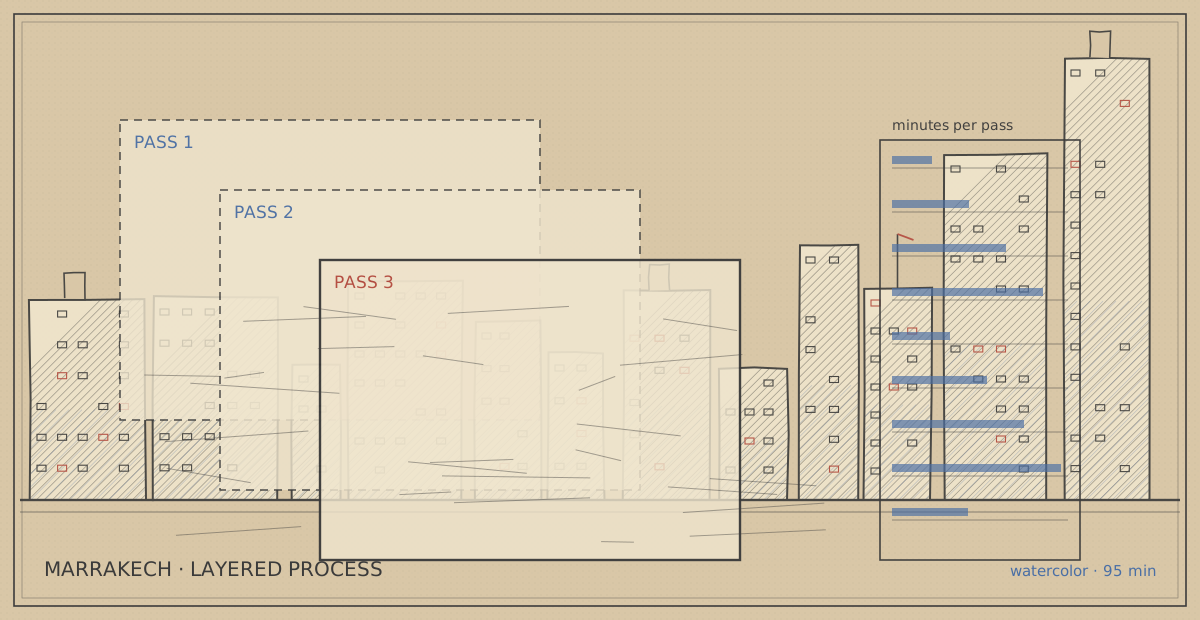
Repairing the second Derb Jdid drawing instead of throwing it away
The first drawing of this doorway was made in the two hours it stays shaded. The second was made three days later, at the wrong time, and it came out flat and grey. Tearing it out was the obvious move and the wrong one — a failed drawing that you still have in front of you is the only one you can learn to repair on.
Place card — The same Derb Jdid doorway, three days later
| Kind | Layered process |
|---|---|
| Coordinates | 31.6295, -7.9811 |
| Country | Morocco |
| Medium | Watercolour |
| minutes on site | 95 min |
| Tools in the bag | Escoda Prado No.4 · 12-pan travel palette · a 4B pencil · a scalpel · Stillman & Birn Beta A5 |
| First published | 26 Oct 2026 |
Diagnosing, before touching it
The drawing sat for two days first, which matters. A failed drawing looked at immediately reads as "bad"; looked at after two days it reads as a list of specific problems.
Four failures, in order of how much damage each did:
| Failure | Symptom on the page | Fixable? |
|---|---|---|
| No value anchor | Nothing is darkest; the eye has nowhere to start | Yes, and it is the whole repair |
| Sunlight painted in | The wall is warm and flat, so the door has no job | Partly — needs the dark to be pushed far enough |
| Line weight uniform | Every edge is the same strength; the door frame is as loud as the mortar | Yes, quickly |
| Scratched, over-painted wall | The lower third has four washes and the paper is tired | No. Accept it and hide it |
The fourth is the honest one. The paper in the lower third is burnished from being washed and lifted three times, and no further paint will sit on it properly. Any repair has to move the viewer's attention away from that zone rather than into it.
Repair one: invent the anchor, and put it where it belongs
The original had no darkest dark. The doorway interior should have been it, but on the day it was painted the door was in bounce light and the interior came out mid-grey.
The fix is to paint the doorway interior again, much darker, over the existing wash. Beta will take a second pass over a fully dry first pass if the mixture is strong and applied in one stroke with a barely damp brush, and the result is a genuinely dark interior with a slight soft edge where the new wash meets the old — which reads as depth rather than as a patch.
Mixture: ultramarine 2, burnt umber 2, alizarin 1. One stroke from the top left corner of the opening to the bottom right, no reworking, brush loaded but not dripping.
| What the anchor does | Effect |
|---|---|
| Gives the eye a starting point | The whole page organises around it |
| Makes the wall read as lit by comparison | The flat warm wall suddenly becomes a lit wall |
| Establishes the interior's depth | The door frame finally sits in front of something |
Repair two: take the warmth out of the wall
With the door dark, the wall was still too warm — a flat ochre with no cool in it. Glazing fixes this, and glazing is the one operation that can be done over tired paper without making it worse, because it adds almost no pigment.
| Area | Glaze | Caution |
|---|---|---|
| Upper two-thirds of the wall | Ultramarine, very thin, one pass | Do not let it pool at the bottom edge |
| Around the door frame | Leave alone | This is the lightest area and must stay warm |
| The wall base | Alizarin plus ultramarine, thin | Adds the coolness of damp masonry |
| Over the tired lower third | Nothing | Any more water here makes it worse |
This is the step that changes the drawing most for the least paint. In a shaded alley, the wall is cool; a warm wall painted from a photograph or from memory is the default error.
Repair three: cut the line weight in two
The original was drawn entirely with the Prado, and every edge has the same weight. Two tools fix it in about fifteen minutes.
The 4B pencil goes on first, over the dry paint, as the heavy line: the stone threshold, the outer door frame's shadow side, the base of the wall. It is grey, not black, and it sits on top of the wash instead of in it, which is exactly what a coarse stone edge looks like.
The scalpel comes second, and it is the tool that makes this repair possible at all. Held almost flat and used as a scraper rather than a blade, it takes the top layer of paint off in a thin line, which produces a bright edge on dry paper without any of the softness of lifting with water.
Three lines only get the scalpel: the top edge of the threshold, the vertical between the two door panels, and the highlight along the left edge of the frame. Three scraped lines in a drawing that had none and the whole thing stiffens up.
What not to do
- Do not add more paint to the lower third. It has taken four washes and cannot take a fifth
- Do not draw the door's iron studs again to "fix" the door. They are the correct weight already and re-drawing them doubles them
- Do not add any object — a pot, a cat, a bicycle — to distract from the flat wall. It never works and it dates the drawing
- Do not tear it out. The repaired version is a worse drawing than the first one and a far better lesson; the first one taught nothing because it went right by accident
Total: 95 minutes over two sessions, of which 25 was diagnosis. The repair added about 12% more pigment to the page and changed which part of it you look at first, which is the whole of what repair can do.