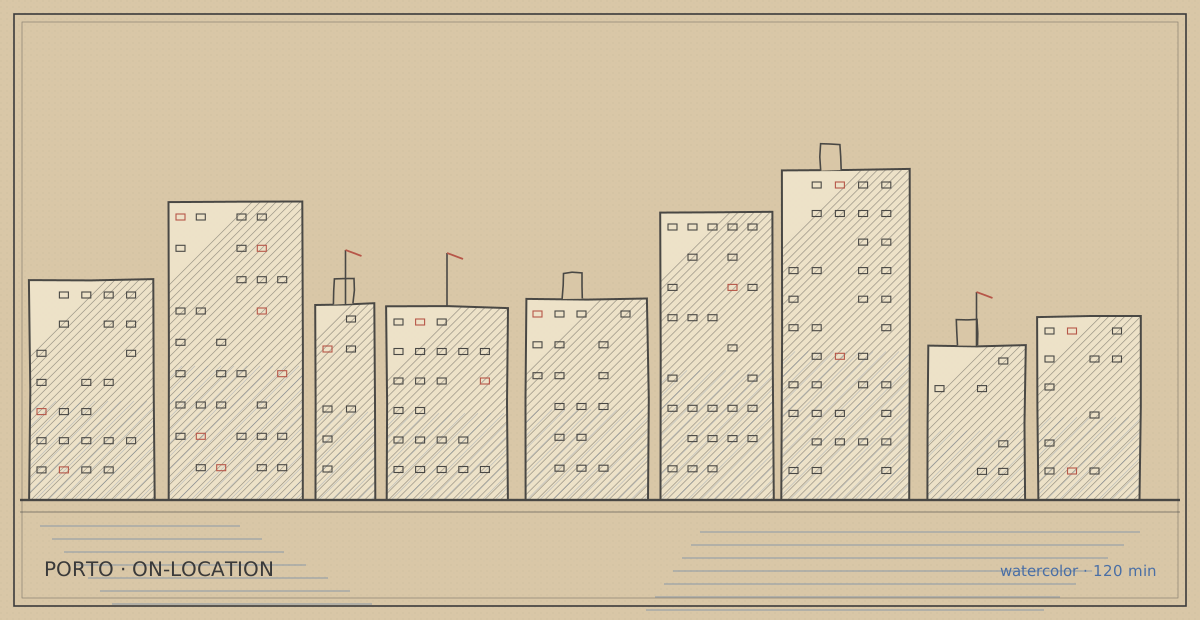
Ribeira's arcade, drawn from the quay wall in two hours
Two hours on the quay wall with the tide going out, drawing the one structure in Porto that punishes you for guessing: twenty-odd identical granite bays in a row, each one narrower on the page than the last, and no room for a rhythm error anywhere.
Place card — Ribeira arcade, Praça da Ribeira
| Kind | Spot sketch |
|---|---|
| Coordinates | 41.1408, -8.6131 |
| Country | Portugal |
| Medium | Watercolour |
| minutes on site | 120 min |
| Tools in the bag | Isabey 6224 No.6 squirrel mop · Escoda Prado No.4 · 12-pan travel palette · Stillman & Birn Beta A5 · 300 ml water bottle · cotton cloth |
| First published | 4 Sep 2026 |
Counting the bays before drawing any of them
The arcade at Praça da Ribeira reads as a repeating pattern, which is exactly why it defeats people who start drawing at one end and work along. A repeating structure has to be *solved* before it is drawn: you need the count, the apparent width of the first bay, the apparent width of the last visible bay, and the spacing between them, or the whole thing drifts and by the fifth bay your arcade has grown.
I counted from the quay wall: 21 visible bays on the long side, of which the last 6 are compressed into a space narrower than the first two combined. Then I marked the page: bay one at the left edge, bay 21 at the right, two thirds of the page height down, and worked out the intermediate positions by halving the interval repeatedly rather than by eye. That took nine minutes and saved the drawing.
The granite problem, mixed from three pigments
Porto granite in flat overcast light is not grey. It is a warm mid-tone with a violet bias in the shadow and a slightly green cast where it has been wet and dried for a century. Mixed as a straight neutral grey it looks like concrete, and the drawing collapses into a car park.
| Mixture | Parts | Where it goes |
|---|---|---|
| Base granite | French ultramarine 3, burnt sienna 2 | All lit surfaces |
| Shadow granite | Base + alizarin crimson, 1 part to 6 | Under each arch, the soffit |
| Wet/dark granite | Base + Payne's grey, 2 parts to 5 | The tide line, the bottom 40 cm |
| Warm bounce | Yellow ochre, thin | Underside of the arches at the top |
The key decision is the shadow. Under each arch the granite goes violet, not darker grey, and using alizarin rather than more ultramarine is what produces that. A neutral shadow here reads as dirt.
Working wet-on-dry, and the one place where the paper has to stay dry
The whole drawing is wet-on-dry: pigment laid on dry paper, one bay at a time, working from the far end toward the near end so that a wet bay never sits next to another wet bay. Twenty-one bays at roughly four minutes each with a two-minute pause for the previous one to lose its sheen is the arithmetic that produced the 120 minutes.
The one exception is the pavement in front of the arcade, which is a single wet-in-wet wash of the base granite laid down first, before anything else, and allowed to dry completely. It has to be one pour because a pavement made of twenty-one separate patches of grey is a pavement that looks like a chessboard. Leaving it to dry flat took eleven minutes during which I did nothing but watch the gulls.
What Beta paper buys you here
Alpha would have worked for the ink drawings but not for this. Beta is 270 gsm and its surface is harder sized, which means a wash flow stops where you put it instead of creeping a further five millimetres into the neighbouring bay. On a structure defined entirely by hard vertical edges between lit and shadowed surfaces, that creep is the whole ballgame.
The cost is weight: Beta A5 adds 60 g and about €4 over Alpha. On a two-hour drawing that is nothing. The honest counter-argument is that Beta's harder surface takes a 0.25 pen slightly worse, so if a page is going to be 95% ink and 5% wash, Alpha is the better choice. This page was 60% watercolour and Beta earned its place.
- Tide: going out, second hour on dry stone
- Interruptions: seven, all of them people taking photographs of the arcade rather than of the drawing
- Wash layers on the darkest arch: four, and the fourth was unnecessary
- One regret: the paper edge curled in the wind during the final wash and left a pale line across the last arch