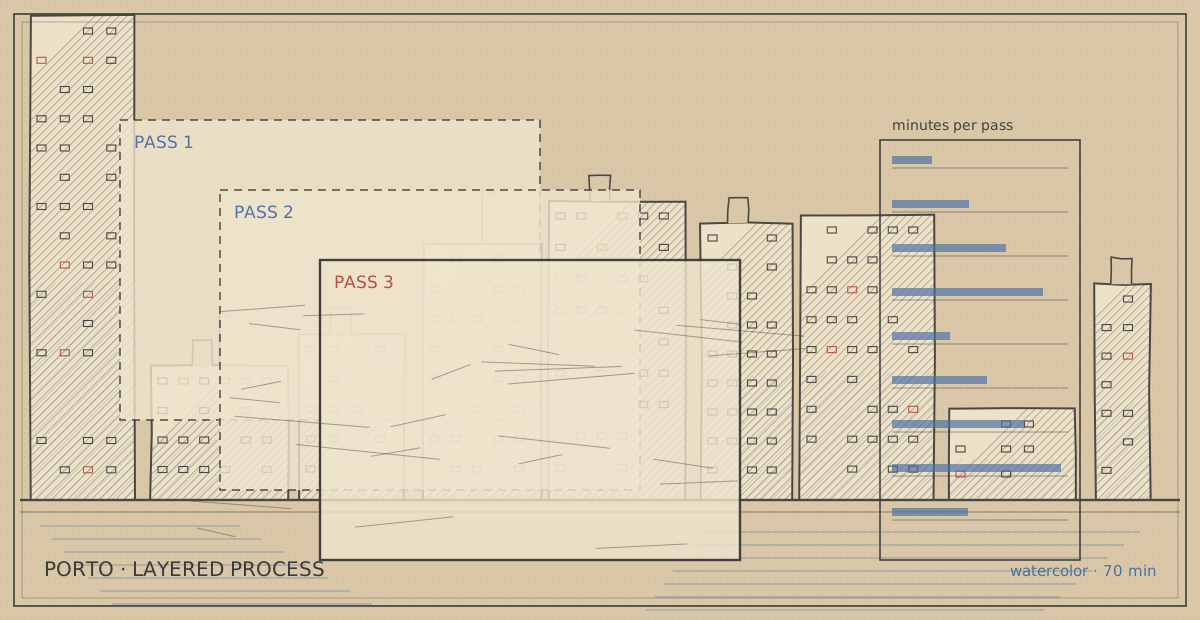
The whole page in two washes, and nothing in between
Two washes is not a style, it is a restriction I set to stop myself from overworking. Four values maximum, decided before the first brush touches the paper, and no third pass no matter how much the drawing seems to need one.
Place card — Rua de São Bento da Vitória steps
| Kind | Layered process |
|---|---|
| Coordinates | 41.1455, -8.6155 |
| Country | Portugal |
| Medium | Watercolour |
| minutes on site | 70 min |
| Tools in the bag | Isabey 6224 No.6 · 12-pan travel palette · Stillman & Birn Beta A5 · 300 ml water |
| First published | 13 Sep 2026 |
Deciding the four values before wetting the brush
The restriction only works if the values are fixed first. On this page I wrote them in the margin in pencil before opening the palette:
| Value | Area | Mixture | Wash |
|---|---|---|---|
| Lightest | Sky, and the top step in full sun | Paper, untouched | None |
| Light-mid | Sunlit stone | Yellow ochre 1, cerulean 1 | First wash, wet-on-dry |
| Dark-mid | Shaded stone, the wall on the left | Ultramarine 3, burnt sienna 2 | Second wash, wet-in-wet |
| Darkest | The shadow under the top step, the doorway | Dark-mid + Payne's grey | Second wash, charged in while wet |
Four values, two washes, and the drawing works because the jump between light-mid and dark-mid is deliberately large. Novice watercolour fails not from too few values but from values that are too close together: if the shaded stone is only slightly darker than the lit stone, all the work in the world will not rescue it.
First wash — 22 minutes, wet-on-dry, and no going back
The first wash covers everything that is not the lightest value: the sunlit stone, the sky if you want one, and nothing else. It is laid wet-on-dry, which means each shape gets one bite of the brush and then is left completely alone.
Two practical rules. Charge the brush fully and touch the paper once per shape; going back over a drying edge lifts pigment and creates a blotch that reads as mud. And mix more than you need in a separate well — a first wash that runs out halfway through the sunlit stair produces a gradient that is not in the drawing and cannot be removed.
On Beta paper this wash took about nine minutes to lose its sheen. I used those nine minutes to mix the second wash and to sharpen the pencil in the bag, which is the only way to keep the timing honest.
Second wash — 34 minutes, wet-in-wet, everything decided at once
The second wash goes down on paper that is damp but no longer shiny. Too early and it blooms; too late and it stops at a hard edge you did not ask for. The test is the back of the hand: if the paper feels cool but nothing comes off, it is ready.
The dark-mid goes on first, across the shaded stone and the left wall, working top to bottom so that the bottom of the page never sits under a wet edge. Then, without waiting, the darkest value is charged in — a small brush loaded with the shadow mixture touched into the wetter parts of the shaded stone, where the brush drags a soft dark shape out of the damp surface. That single operation is the whole reason for the second pass: those soft dark shapes cannot be produced any other way.
The one thing this pass cannot do is carry a hard edge. If a shadow needs a crisp boundary — the doorway on the left, the line of the top step — it has to be in the *first* wash, not this one. Getting that wrong on a stair drawing is expensive, because stairs are read entirely through their edge lines.
Where I broke the rule, and whether it was worth it
Twice. Once to lift a hard edge out of the sky with a thirsty brush and a clean tissue — a correction rather than a third pass, and it improved the page. Once to add a single stroke of concentrated dark behind the doorway, which was a genuine third pass and did not improve anything; it flattened the shadow that the second wash had built and made the doorway look like a hole cut in paper.
The rule survives the experiment, with one amendment: a correction performed within the same wash is allowed, and anything after the paper has fully dried is a new pass and a mistake.
- Total: 70 minutes, two washes, four values
- Water used: about 120 ml of the 300 carried
- Dry time between washes: nine minutes
- Worth repeating: yes, but only on a subject with strong light — this method has nothing to say about a flat overcast day