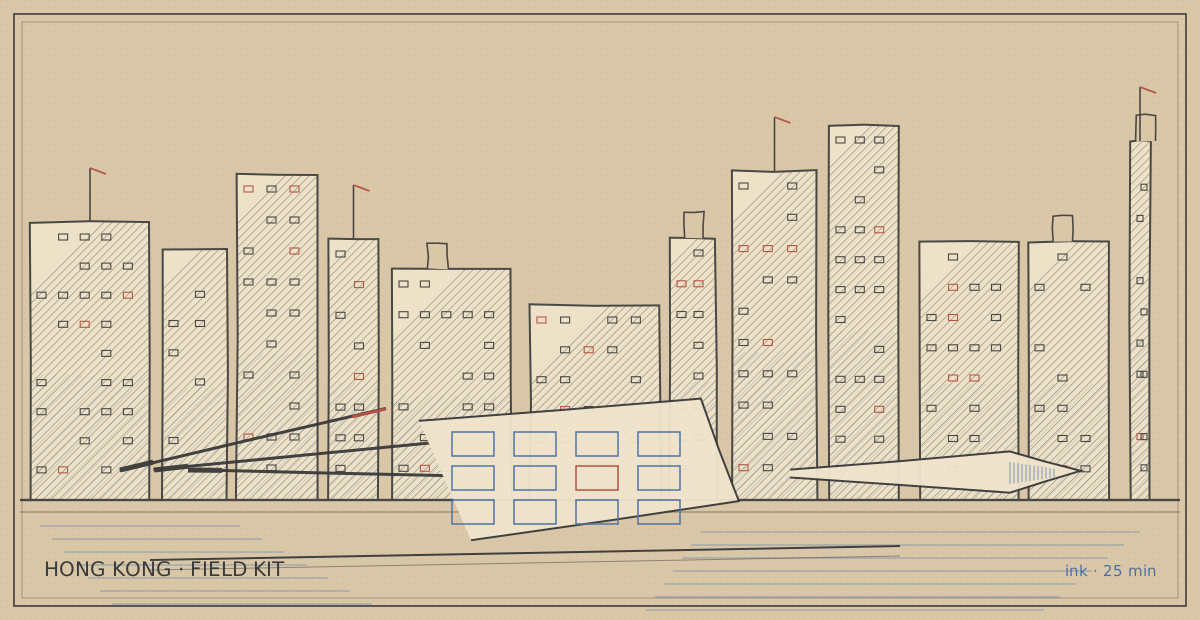
The 640 g bag that fits under a bus seat
A commute kit is not a smaller version of a plein-air kit. Its constraint is not size but the ability to be opened, used and closed in the ninety seconds between two stops, without spilling anything on a stranger.
Place card — Wan Chai, on the number 10 bus
| Kind | Field kit |
|---|---|
| Coordinates | 22.2783, 114.1747 |
| Country | Hong Kong SAR |
| Medium | Ink |
| minutes on site | 25 min |
| Tools in the bag | A5 zip pouch · Sakura Pigma Micron 045 · Kuretake brush pen · Stillman & Birn Alpha A5 · 100 ml water bottle · ten-pan tin |
| First published | 20 Oct 2026 |
What is in the bag
| Item | Weight | Why it earns its place |
|---|---|---|
| A5 zip pouch, canvas | 90 g | The zip is the whole point: nothing falls out when the bag is tipped |
| Alpha A5, 110 gsm | 180 g | Takes ink without bleed and survives being leaned on |
| Micron 045, two of them | 10 g | One lives in the pouch, one in a jacket pocket |
| Kuretake brush pen | 22 g | A single dark mass in one stroke, which is what a moving subject needs |
| Ten-pan tin, refilled | 130 g | Ten, not twelve; two pans were never used |
| Water bottle, 100 ml | 120 g (full) | A flat bottle, so it fits beside the book |
| Cotton cloth, 12 cm | 15 g | Cut down from a full one; a full one is dead weight |
| Total | 567 g | Plus the bag's strap and a pencil, about 640 g |
The two-pen rule is the only redundancy in the kit and the only one worth carrying. Pens run out, and a commute drawing has one window; a spare pen costs 5 g and saves the session.
The nine things that were removed
Each of these was in the bag at some point, and each was removed only after the discomfort of not having it turned out to be smaller than the discomfort of carrying it.
| Removed | Why it went |
|---|---|
| Watercolour palette and brush | Used twice in four months; the brush pen covers the same ground in a moving vehicle |
| Pencil and eraser | A commute drawing is never pencilled first; nobody can see a mistake at 40 km/h |
| Second sketchbook | A whole second book carried for the one day in twenty the first fills up |
| Ruler | Used once, for a tram window, and the line was worse for it |
| Kneaded eraser | No pencil, no eraser |
| Folding stool | Physically impossible on a bus, and there are seats |
| Phone tripod | The one photo you want, you can take by hand |
| Pencil case | The pouch *is* the pencil case; the case inside the pouch was 40 g of nothing |
| Six more pens in six colours | The drawing is ink on paper, and the brush pen is the second tone |
The ninety-second test
The whole kit has to pass one test: from bag closed to first mark in ninety seconds, and from last mark to bag closed in thirty, seated, without standing up.
The current layout does it in about seventy. The reason is that the pouch opens flat and everything inside is visible at once — the book, the pen, the brush pen, the tin, the cloth, each in a fixed place, no layers. Any kit that requires unpacking has already failed on a bus, and the failure is not that you cannot draw; it is that you spill something.
What to draw in the time you have
The commute kit implies a subject range. With 25 minutes and moving ground, three subjects work and everything else does not.
- Faces on the opposite row — never, in a city where people notice
- Hands and forearms of the person beside you — the best subject on public transport, and the one nobody objects to
- The window and what is beyond it — the marks are yours and the view is free
- The interior structure — grab poles, handstraps, the ceiling line, drawn between two stops as a repeated rhythm
- A single object, drawn five times — a handstrap, five attempts, 90 seconds each; the fifth is a drawing
The last one is what turns a commute into practice rather than a sketchbook of fragments. Five attempts at the same handstrap on the same journey, and the difference between the first and the fifth is the whole of what a commute kit is for.
On weight: 640 g is about a third of a litre of water. That is the number to hold against any new item — an item has to be worth a third of a litre of water, every day, on the off-chance it is needed.