A night alley drawn dark-first, then rescued
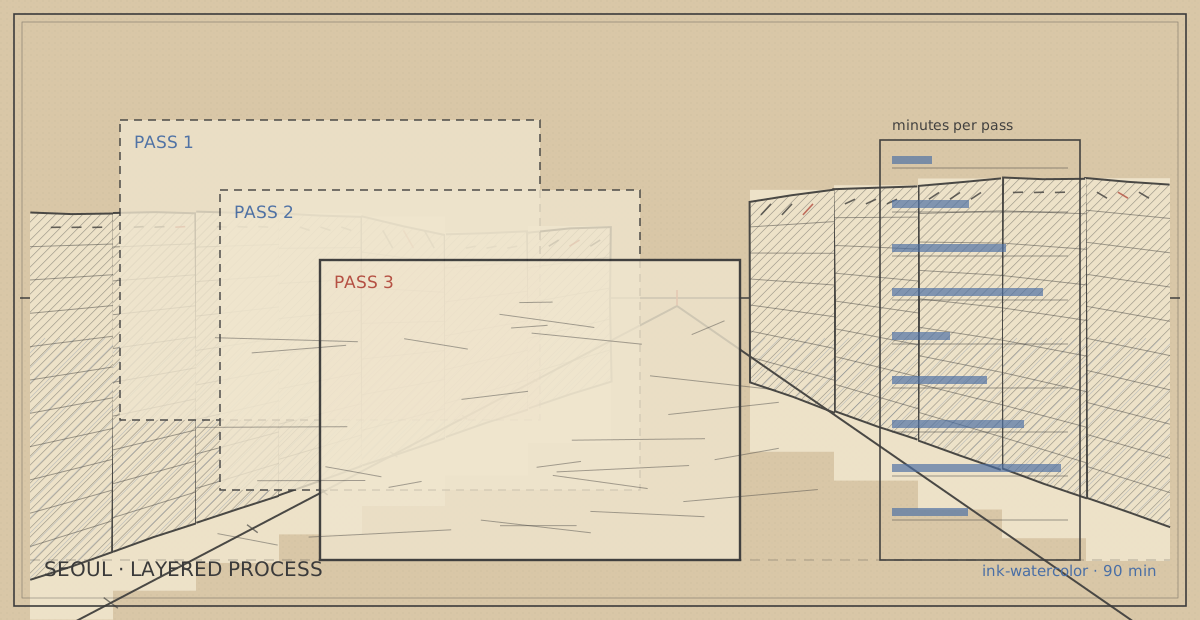
Night drawing fails for a structural reason, not a skill reason: at night the dark is the subject and the light is the gaps in it, and a drawing built from outlines has it the other way round. This is 90 minutes in a Seoul back alley, painted in the order the eye actually reads it.
Place card — Euljiro back alley, after dark
| Kind | Layered process |
|---|---|
| Coordinates | 37.5704, 126.9830 |
| Country | South Korea |
| Medium | Ink and wash |
| minutes on site | 90 min |
| Tools in the bag | Sakura Pigma Micron 045 · Isabey 6224 No.6 · 12-pan travel palette · Stillman & Birn Beta A5 · head torch with red filter |
| First published | 8 Oct 2026 |
The mistake that produced this method
The first two times I drew a night scene, I drew it like a day scene: outlines first, then tone. Both pages came out as day scenes with dark patches, which is exactly what they were.
The reason is structural. At night, the *dark* is the subject and the light is the gaps in it. A drawing built from outlines has the light as the subject and the dark as filling, and no amount of darkening afterwards changes which of the two the drawing is about. The fix is to build the page in the order the eye actually reads it at night: big dark shapes first, then the lights carved out of them.
Pass one: the three dark shapes, before any line
At night on a narrow alley, everything reduces to three dark masses and one light. Identifying them takes about five minutes of looking, and they are almost never the objects you expect.
| Shape | What it is here | Value |
|---|---|---|
| Dark 1 | The upper two-thirds of both walls, above the shop signs | Near-black |
| Dark 2 | The road surface, unlit except for two pools | 70% |
| Dark 3 | The alley's far end, and the gap between two buildings | Solid black |
| Light | Two shopfront signs, one window, and the wet reflections under them | Paper, untouched |
Dark 3 is the one people miss. A night alley has a black hole at the end of it, and that hole is what gives the drawing its depth. Without it, the drawing is a corridor with no exit, and the eye stops moving.
Pass two: laying the darks, wet-in-wet and without hesitation
All three darks go in during one fourteen-minute window, wet-in-wet, working from the far end forward. The mixture is the same for all of them — ultramarine, burnt sienna and Payne's grey at roughly 3:2:2 — with the difference between the three made by *how many times* the brush passes, not by changing the mix. A single mix and three passes gives a family of darks that read as one night; three different mixes give three different materials pretending to be night.
Drying time is the enemy here. Beta paper gives about nine minutes of working time before a wet edge stops blending, so the far end has to be painted first and worked toward the near end, never the reverse.
Pass three: pulling the lights back out
This is where the drawing is actually made. With the darks still slightly damp, the lights are taken out with a clean, thirsty brush and, where the light needs an edge, with a dry corner of the cloth pressed rather than wiped.
Three specific operations:
- The two sign rectangles — lifted with a clean brush, then their lettering drawn in with the 045 over the pale shape once it dries
- The window — left as paper from the start, with a single hatched band across it to suggest glass rather than a hole
- The wet road reflections — drawn with the 045 as short horizontal strokes in the *damp* dark, which produces a slightly blurred line as the ink spreads, and that blur is exactly what a reflection looks like
The reflections are the part that makes the page read as night rather than as a brown alley. They only work on damp paper, so they have to be done in a two-minute window and cannot be redone later.
The one thing that has to be drawn with a line
The overhead cable. In a night alley, cables above a lit sign are the only element that is *lighter* than what is behind them, because the sign is lighting them from below. Drawing a light line on a dark ground means leaving the paper alone and hatching around the cable, which takes twice as long as drawing the cable and is the only way to get it right.
Everything else — the doorframes, the bollards, the second-storey windows — is drawn as a boundary between two darks, not as an object. There is no such thing as a door in this drawing; there is a rectangle where one dark stops and another begins.
- Head torch: red filter only. White light destroys night vision for about twenty minutes and makes every wash look blue
- Total: 90 minutes, of which 14 were the darks and 11 were the lights
- Water used: 90 ml, half of what a daytime drawing of this size takes
- One failure kept: the left sign was lifted twice and has a faint halo where the damp paper was bruised