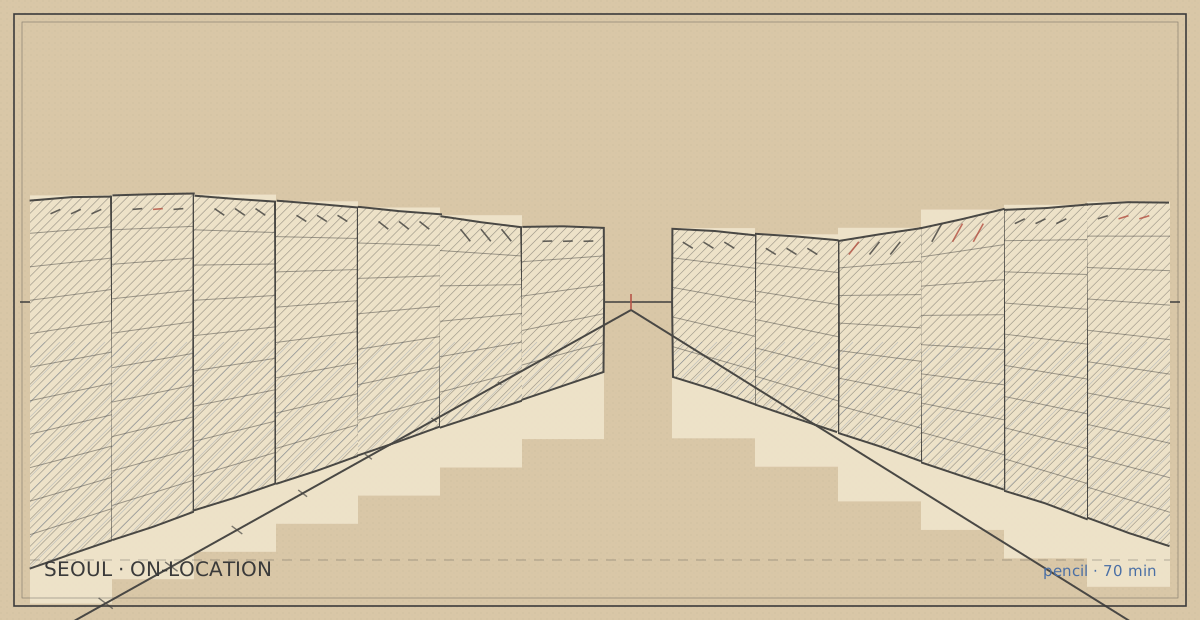
Bukchon's roofline in graphite, no ink at all
No ink in the bag for this one, deliberately. A hanok roof is a repeating tile sequence on a curved surface, and graphite is the only medium that lets you build the tone up in layers and take it back down again — which is what a curved surface demands when you get the foreshortening wrong.
Place card — Bukchon-ro 11-gil, above the hanok roofs
| Kind | Spot sketch |
|---|---|
| Coordinates | 37.5826, 126.9830 |
| Country | South Korea |
| Medium | Pencil |
| minutes on site | 70 min |
| Tools in the bag | 0.5 mechanical pencil · 2B and 4B lead · kneaded eraser · Stillman & Birn Alpha A5 |
| First published | 18 Sep 2026 |
Why a roof tile is the best pencil subject there is
A hanok roof gives you three separate problems stacked on top of each other, and each is best solved in graphite.
The tile rows are a repetition, which means an error in the first row multiplies all the way up the roof. The surface is curved, which means the apparent width of a tile row changes continuously from the eaves to the ridge. And the whole thing is a value problem in a narrow range — the tiles are all dark, and the drawing lives or dies on the tiny differences between them.
Ink cannot do the third one. Once a tile is inked dark, it is dark, and a roof in which every tile is the same dark is a roof that looks like a tarmac skip.
Value plan, decided in the first five minutes
| Zone | Where | Technique |
|---|---|---|
| Lightest | The ridge highlight and the sky gaps | Paper, protected with a kneaded eraser |
| Light-mid | Upper third of the roof, catching sky light | 2B laid flat, single pass, no pressure |
| Mid | The bulk of the tiled surface | 2B plus a second pass at 45 degrees |
| Dark-mid | The deep channel between tile columns | 4B, one stroke per channel |
| Darkest | Underside of the eaves, and the tile ends at the bottom | 4B, pressed, edges kept hard |
The single most useful decision was to keep the darkest value for the *eaves* and the tile ends, not for the middle of the roof. Most people darken the whole roof and leave the eaves light, which inverts the light and makes the roof float.
The tile rows, counted and then not drawn
I counted eleven tile columns visible from where I sat. Eleven columns across the roof, and the columns themselves get narrower toward the top of the roof by roughly 8% per column as the surface curves away.
The mistake is to draw eleven. What reads as eleven columns from the street is, on paper, four fully drawn columns at the bottom, three more reduced to parallel lines with no individual tile detail, and the rest simply omitted behind the ridge. The count in the drawing does not have to match the count in the world; what has to match is the *rate of narrowing*, because that is what tells the eye the roof is curved.
Practising the narrowing rate separately, on a scrap page, is worth ten minutes before starting. Draw eleven vertical lines, make each one 8% shorter and 8% closer to its neighbour than the last, and look at it. That single exercise is most of what this drawing is.
The eraser is a drawing tool here
A kneaded eraser is what separates a graphite roof from a graphite smear. On this page it did three jobs:
- Lifting the ridge highlight out of a mid-tone that had already gone too dark, which no amount of leaving-the-paper-alone preparation would have fixed because the roof curve was misjudged at the top
- Cutting the thin pale line between two tile columns, where the drawing needed a light edge rather than a dark one
- Softening the very bottom edge of the eaves shadow so the roof does not appear to be pasted onto the page
Pressed graphite cannot be erased cleanly, so the lightest values have to be planned from the start. The kneaded eraser lifts 2B but only lightens 4B, which is a hard ceiling on how much correction is possible.
- Time: 70 minutes, no interruptions, sitting on a low wall
- Lead used: approximately 3 cm of 2B, 1.5 cm of 4B
- One deliberate omission: the modern apartment block behind the roofline is not drawn at all
- Would ink help: not on this subject. On a stone or tile street, yes; on a curved repeated surface, no