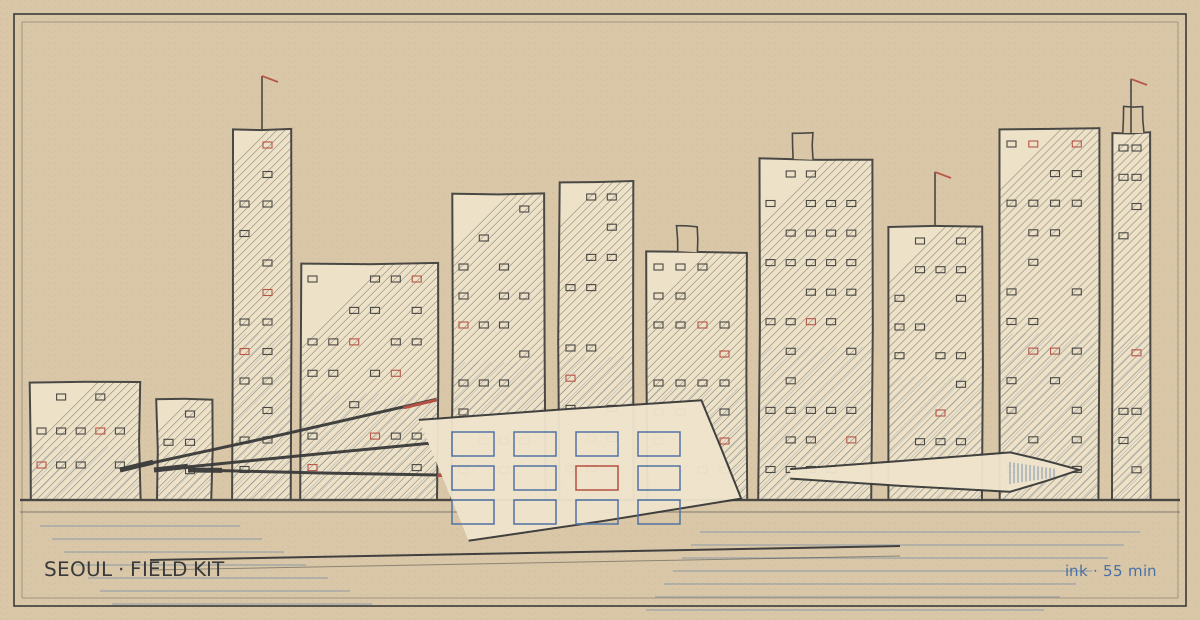
Three nibs, one page, and a rotation order that stops the mud
Three pens is not a collection, it is a system, and a system only works if the order is fixed. The order I use is 045 first, 025 second, 08 last — which is the opposite of what most people do, for reasons that took about thirty bad pages to work out.
Place card — Cheonggyecheon walkway, Seoul
| Kind | Field kit |
|---|---|
| Coordinates | 37.5665, 126.9780 |
| Country | South Korea |
| Medium | Ink |
| minutes on site | 55 min |
| Tools in the bag | Sakura Pigma Micron 025 · Sakura Pigma Micron 045 · Sakura Pigma Micron 08 · Stillman & Birn Alpha A5 |
| First published | 20 Sep 2026 |
The rotation, and why the fat nib goes last
| Order | Nib | Job on the page | Share of the session |
|---|---|---|---|
| 1 | 045 | Structure: edges, corners, every boundary between two surfaces | About 45% of the drawing time |
| 2 | 025 | Texture and tone: hatching, lettering, small openings | About 40% |
| 3 | 08 | Emphasis: three to five strokes only, on the nearest dark shapes | Under 5 minutes |
The 08 last is the whole trick. A fat nib used early sets a heavy line weight that everything else has to live up to, and the page ends up uniformly heavy — which is another way of saying it ends up flat. Used at the end, on three or four strokes, it does the one thing no thin nib can do: it makes the near edge of the drawing come forward. On this Cheonggyecheon page it went on the underside of the bridge parapet, the dark gap between two wall blocks, and the café sign, and nowhere else.
The other counter-intuitive part is starting with 045 rather than 025. A 025 outline looks delicate and precise, and it is, which is the problem: it commits you to a fine, even, illustrative look before you have decided anything about structure. Starting at 045 means the drawing has a strong skeleton, and the 025 can then be used for what it is actually good at, which is tone rather than edges.
The two rules that stop a page going grey
Rule one: never outline with the same nib you hatched with. When hatching is bounded by a line of identical weight, the hatch merges into the outline and the whole shape becomes a flat grey patch. The 045 skeleton keeps the 025 hatch contained, and the difference in weight is what makes the hatch read as a surface rather than as dirt.
Rule two: keep a nib's total ink budget in mind. A Micron 025 covers roughly 40 metres of line before the tip starts to blunt and the line widens. Blunt nibs are invisible in the hand — you cannot feel the change — and then you look at a page and the hatching in the lower half is mysteriously coarser than the hatching at the top. Replacing the 025 every seven or eight A5 pages is cheaper than replacing a drawing you spent two hours on. Writing the date on the barrel with a paint pen is the low-effort way to track it.
What the fat nib is for, and what it is not for
The 08 is not for drawing bigger. It is for drawing the *nearer*. Three legitimate uses:
- The underside of anything you are sitting under — a bridge, an awning, an arcade soffit
- Any gap between two light surfaces that is in fact a shadow and would otherwise look like a mistake
- Lettering, where the size of the letters genuinely justifies the weight
One illegitimate use, and it is the common one: outlining a whole foreground object. It feels decisive and it kills the depth relationship in the drawing, because a uniformly heavy outline reads as "this object is important" rather than "this object is close".
The carry cost, and a note on going down to two
Three pens is 25 grams and about €10, which is nothing. The real cost is decision fatigue: at the start of every sketch you have to choose a nib, and a bad choice means either re-drawing or living with it.
If I were cutting to two, I would keep the 045 and the 08, and get the missing texture by varying the pressure of the 045 and by using a pencil for hatching instead. That combination covers structure and emphasis, and texture is the one job the pencil can do almost as well as the 025. Going to one pen — which is what most people start with — leaves you using the same nib for every job, and the page shows it: outlines the same weight as the hatching, which is the single most recognisable beginner's signature on paper.